Introduction
This is a link created using the Link component: Go to the next page
sidebar_position: 1
Embodied Intelligence: Where AI Meets the Physical World
Welcome to the Physical AI & Humanoid Robotics educational platform - a comprehensive guide to building intelligent robotic systems that bridge the gap between artificial intelligence and physical reality.
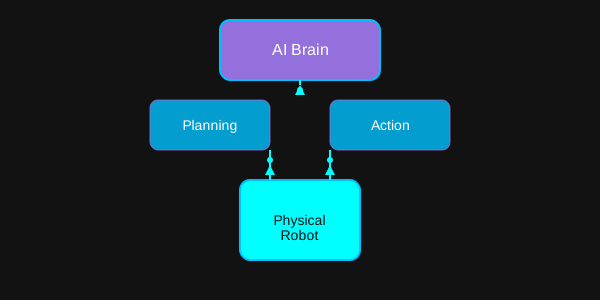
Humanoid Robot Control Architecture: AI Brain → Action Planning → Physical Execution
The Physical AI Revolution
Modern robotics is experiencing a paradigm shift. Today's robots are no longer simple programmable machines but intelligent systems capable of perceiving, reasoning, and acting in complex physical environments. This convergence of AI and robotics—known as Physical AI—represents the next frontier in intelligent automation.
Core Learning Modules
This platform is organized into four interconnected modules that build your expertise from foundational concepts to advanced integration:
Module 1: ROS 2 Nervous System
Communication & Coordination
- Core ROS 2 architecture, nodes, topics, services, and actions
- Distributed system design for robotic applications
- Real-time communication patterns
Module 2: Digital Twin (Gazebo/Unity)
Simulation & Validation
- Physics-based simulation environments
- Sensor simulation and data processing
- Virtual testing and validation
Module 3: NVIDIA Isaac AI-Robot Brain
Perception & Intelligence
- Deep learning integration for robotics
- Perception systems and computer vision
- Planning algorithms and decision making
Module 4: Vision-Language-Action & Humanoid Capstone
Integration & Autonomy
- Multimodal AI systems
- Human-robot interaction
- Complete humanoid control systems
Capstone Challenge: Autonomous Humanoid
Voice
"Go to the kitchen and bring me water"
Plan
Navigation, object recognition, manipulation
Act
Physical execution in environment
Technical Prerequisites
Before starting this program, you should have:
- Programming: Proficiency in Python and/or C++
- Mathematics: Understanding of linear algebra, calculus, and probability
- Systems: Familiarity with Linux command line and Git
- Robotics: Basic knowledge of kinematics and control systems (helpful but not required)
Learning Approach
Each module combines theoretical foundations with hands-on practice:
- Conceptual Understanding: Mathematical and algorithmic foundations
- Practical Implementation: Code examples and exercises
- Simulation Integration: Testing in virtual environments
- Real-World Application: Connection to physical robotics
The platform supports multiple languages, with English and Urdu currently available, and includes interactive simulations for an immersive learning experience.
Target Audience
This platform is designed for:
- AI and robotics engineers
- Graduate students in robotics and AI
- Researchers in embodied intelligence
- Industry professionals transitioning to robotics